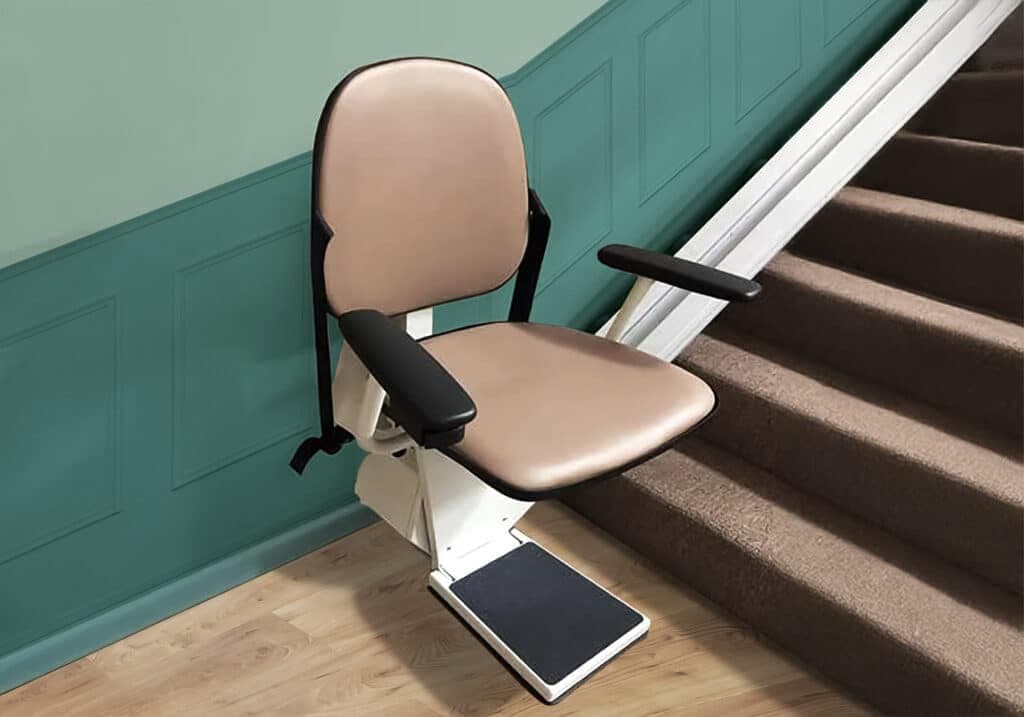
Not every staircase runs in one straight line. Many homes have stairs that turn at a landing, wrap around a corner or change direction partway up. For those staircases, a curved stair lift is the solution: a stair lift whose rail is shaped to follow the exact path of your stairs.
How a curved stair lift works
A curved stair lift works much like a straight one. You sit in a padded chair, fasten the seat belt and use a simple control to ride between floors. The difference is the rail. Instead of one straight length of track, a curved rail bends through landings and around corners, so a single ride carries you from the bottom of the stairs to the top without getting off partway.
Because the chair travels through turns, curved models are designed to keep the seat level and steady as the rail changes angle.
When do you need a curved stair lift?
You'll likely need a curved stair lift if your staircase has:
- A landing partway up, even if both sections are straight
- A turn of any angle, such as an L-shaped or U-shaped staircase
- A curve or spiral section
- More than one flight you'd like to cover in a single ride
If the stairs run in one uninterrupted line from floor to floor, a straight stair chair is usually the better and simpler fit.
Why curved rails are made for your home
Every curved staircase is a little different, so a curved rail is planned around the measurements of your specific stairs. That's the main reason curved stair lifts involve more planning than straight ones: the rail has to match your staircase's turns, landings and angles precisely.
Expect a careful measuring step before anything is ordered, and a longer lead time than a straight system because the rail is made to fit.
Can you use two straight stair lifts instead?
Sometimes two straight stair lifts can serve a staircase with a landing, one for each section. It can work, but it means getting off at the landing, walking to the second chair and sitting down again. For many people, that transfer in the middle of the stairs is exactly what they're trying to avoid, which is why a single curved stair lift is usually preferred.
If the stairs turn, the rail needs to turn with them. That's the whole idea behind a curved stair lift.
Questions to ask about a curved stair lift
- Where will the chair park at the top and bottom, and will it block a doorway or hallway?
- Can the rail extend past the top step so the seat swivels onto the landing safely?
- How will the rail handle each turn and landing on your staircase?
Curved stair lift FAQs
Does a curved stair lift take longer to install than a straight one?
Usually, yes. A curved stair lift rail is planned around your staircase, so there's a measuring step and a longer lead time before installation, and the installation itself involves more work at each turn and landing.
Can a curved stair lift go around more than one turn?
Yes. Curved rails are designed for staircases with one or more turns, landings and changes in direction, so a single ride can cover the whole staircase.
Can a curved stair lift be moved to another home?
Because a curved rail is shaped for one specific staircase, it generally can't be reused on a different staircase. That's worth keeping in mind if you expect to move soon.
Curved stair lifts in the Tri-State area
Tri-State Stair Chair installs curved stair lifts for homes across Illinois, Missouri and Iowa. Learn more about curved stair chairs, or call us and describe your stairs; it's usually enough to tell which system you need.